
A model can be accurate and still fail to create value. The real test begins when it leaves the classroom: Does it improve a decision? Can people trust it? Can an organisation actually put it to work?
Those questions followed the PGP in Artificial Intelligence & Data Science cohort through its two-week Study Abroad Module at Nanyang Business School, part of Nanyang Technological University (NTU), from August 24 to September 4, 2026.
The module moved across three connected strands — academic learning, industry exposure and cultural immersion — giving students the opportunity to examine AI not simply as a technology, but as a business capability.
Academic Courses
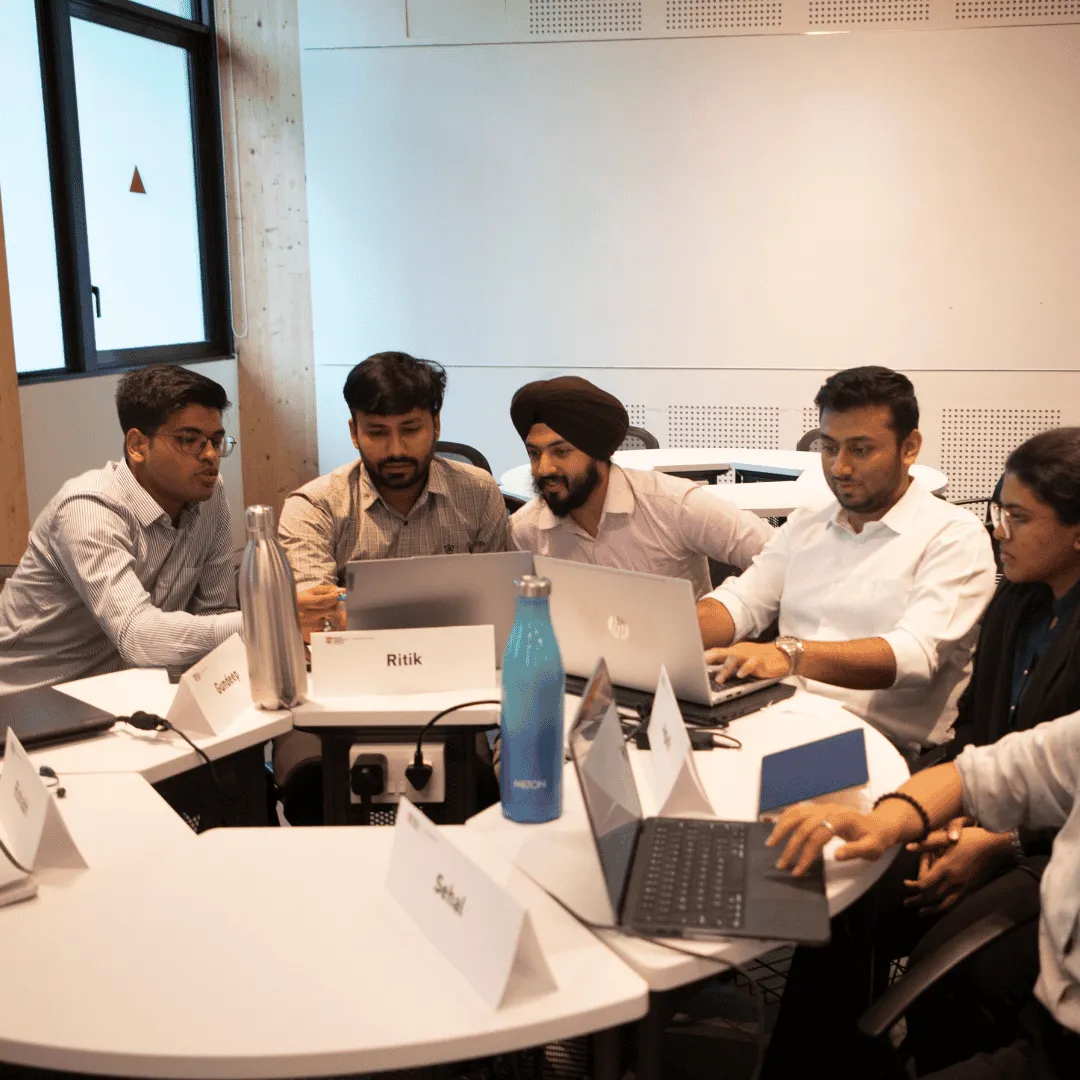
In the classroom, two courses formed the academic backbone of the programme. Prof. Anandsivam Gopal, Professor of Information Technology & Operations Management, led Strategies for Digital Transformation, exploring what happens after an organisation adopts a new technology: how it changes processes, decisions and ways of working. Asst Prof. Vivek Choudhary followed with AI and Business Applications, taking students from regression and classification trees to clustering while continually bringing the discussion back to business context.
Across both courses, a consistent lesson emerged: technical capability is only one part of the equation. Clear communication, managerial judgement and an understanding of the problem being solved determine whether a model becomes useful in the real world.
Industry Exposure
The industry visits brought that lesson into sharper focus.
At Atos Singapore, students explored AI sovereignty and agentic systems, gaining insight into what responsible AI deployment looks like at enterprise scale. At the Hyundai Motor Group Innovation Center Singapore (HMGICS), AI, sensors and automation came together on a live factory floor, demonstrating how advanced technology can transform physical operations while still relying on human oversight. At Standard Chartered Bank in Changi, conversations with AI leaders offered a view into the particular challenges of introducing new technologies within a highly regulated global institution.
Each setting presented a different version of the same question: how does an organisation move from experimenting with AI to making it work at scale?
The programme culminated in Convergence 2026, Jio Institute's flagship international conference. Students from the cohort moderated panels featuring industry leaders, bringing them from the role of learners to participants in a live conversation about how AI is reshaping business.
Cultural Immersion
Singapore itself became another part of the learning experience.
From the SkyPark Observation Deck and the Marina Bay skyline after dark to the Fort Siloso Skywalk and a day at Universal Studios, the cohort experienced a city shaped deliberately around movement, accessibility and the people who use it. Even outside formal sessions, the city offered examples of how systems, technology and human behaviour intersect.
By the end of the two weeks, the distinction between a good model and a useful one had become difficult to ignore.A model that predicts well is not automatically valuable. It has to address a real problem, support a decision someone needs to make, be understood well enough to earn trust, and be monitored closely enough for its limitations and errors to be recognised. That lesson was as visible on the HMGICS factory floor as it was in a classroom exercise on classification trees.
For a cohort learning to work at the intersection of data and business, this became more than an academic takeaway. It was the central thread running through the entire experience: build the model, but do not stop there. Ask what it is for, who will use it, and what happens when it gets it wrong.
Singapore gave the cohort two weeks to ask those questions — in the classroom, on the factory floor and inside a bank — and to see what it takes to turn intelligence into impact.