
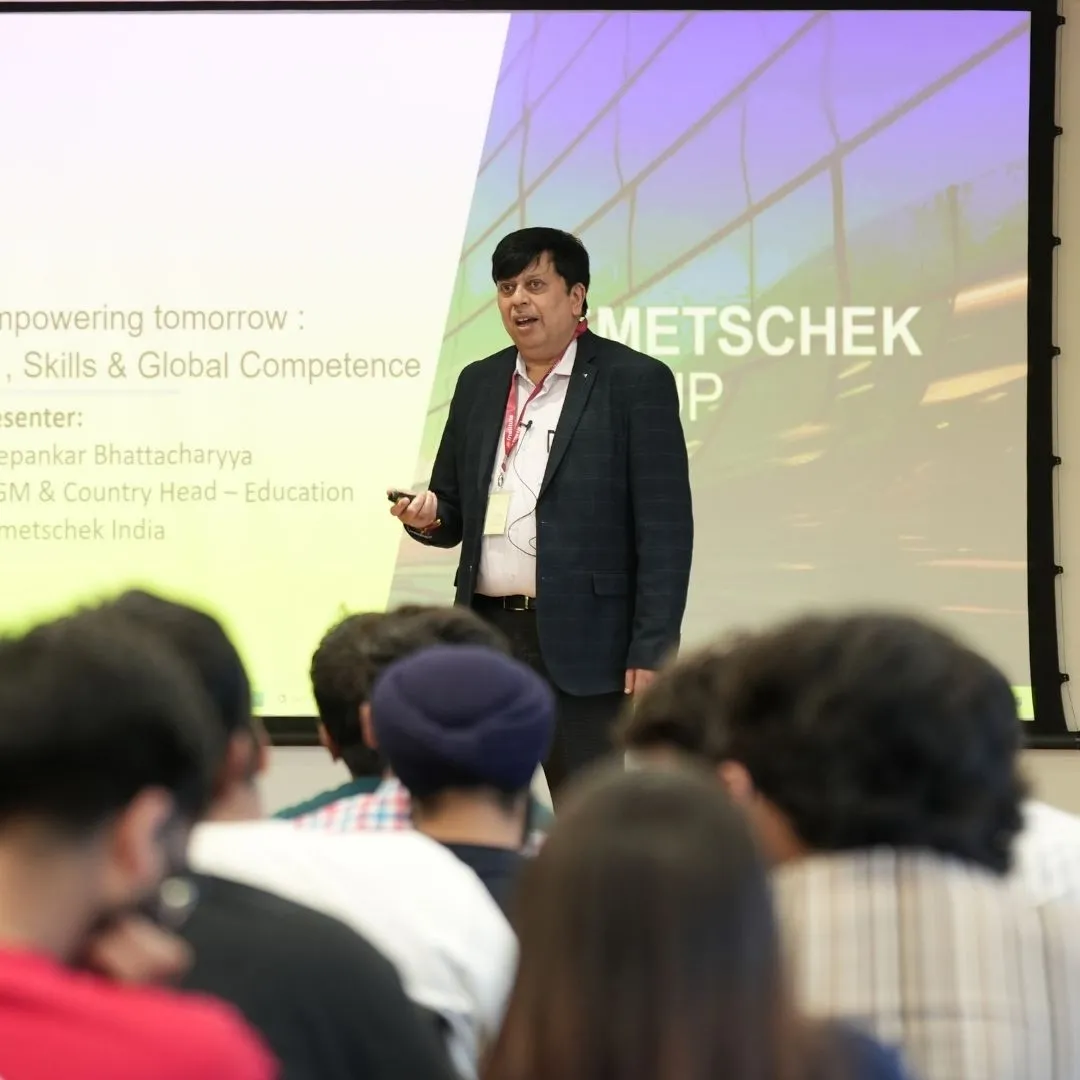
The Institute had the privilege of hosting Mr Deepankar Bhattacharyya, Senior General Manager & Country Head - Education at Nemetschek India. The session was an engaging, forward-looking dialogue that shifted the focus from simple textbook learning to the real-world skills required to build the future.
Headquartered in Munich, Germany, the technology giant Nemetschek has spent 60 years quietly shaping global infrastructure and building a footprint that spans iconic international projects. Backed by the company’s global reach of over 7 million users, Mr Bhattacharyya brought decades of personal industry expertise directly into the lecture hall.
The Reality of India’s Infrastructure Boom
Mr Bhattacharyya challenged the passive narrative that India is merely an "emerging" market, demonstrating with hard reality points that the country is currently undergoing an unprecedented construction revolution.
The scale of development requires a massive influx of digitally skilled talent, creating a substantial demand-supply gap that upcoming professionals need to fill. To put this into perspective, he highlighted a stark mismatch in numbers:
"India produces about 16 lakh engineers every year across all disciplines. If we break down the maths, only about 4 lakhs graduate from civil or architecture streams annually. Yet, by 2030, the Architecture, Engineering, and Construction (AEC) sector alone will require 30 million digitally skilled professionals. That is a demand for 3 crore experts against a fraction being trained."
Key Statistics Driving the Frontier:
- The Population Shift: By 2030, almost 600 million Indians will be living in cities, necessitating massive urban expansion, smart city development, and redevelopment.
- Housing Demand: India requires 25 million affordable homes by 2030.
- Global Standing: Having recently overtaken the United States, India is officially the second-largest infrastructure market in the world.
- Iconic Validation: Nemetschek’s proprietary tools (such as Archicad) have been behind major national and international milestones, including the design of India’s new Parliament building (Central Vista) and the Paris Olympic Athletes Village.
Key Takeaways: Re-imagining AI and Sustainability
AI is an Invitation, Not a Threat
Instead of viewing Artificial Intelligence as a job-stealer, Mr Bhattacharyya framed it as the ultimate productivity enabler. The goal of technology is to eliminate mundane tasks so professionals can focus on intellectual property—their brains. He shared a powerful anecdote from a peer at Google to illustrate the shift:
"He used to have 80 people reporting to him; today, he has 150 AI agents working in the background to aid his day-to-day jobs. Our own CEO noted that while we aren't reducing headcounts, we expect our people’s productivity to scale exponentially using AI."
The Four Pillars of Modern AEC
The industry is moving away from fragmented workflows and turning toward four defining technical trends:
- Interoperability: Different software systems must integrate seamlessly to prevent data loss
- Generative Design: A paradigm shift where AI helps generate optimized architectural layouts based on set parameters
- Digital Twins: Creating precise 3D intelligent digital models of physical structures via cloud data points—crucial for managing heritage buildings where older blueprints do not exist
- Sustainability: Addressing the critical fact that 40% of global carbon emissions are caused by the construction industry, requiring accurate software planning to curb the 20% material waste currently lost to poor logistics
Student Q&A Highlights
The interactive section of the afternoon gave students a chance to pitch direct queries regarding industry monopolies, software implementation, and the technological architecture of Nemetschek's product suite.
Q: I am familiar with Autodesk. How are Nemetschek's tools different from, or what are they doing differently from, existing Autodesk products?
Mr Bhattacharyya: "Autodesk has been in the Indian market for a longer period, resulting in a larger install base. However, while they are traditionally very strong in the planning and design phase, they do not cover the entire lifecycle as robustly. Our Unique Selling Proposition (USP) lies in unison across the entire AECO lifecycle—spanning planning and design, building and construction, through to operations and management. Furthermore, modern industry consumers do not want to rely on a single technology provider to avoid monopolistic risks. That’s where interoperability comes in; our software allows systems to talk to each other seamlessly."
Q: How is Nemetschek implementing AI into their products for consumers?
Mr Bhattacharyya: "We have a dedicated AI division addressing the shifting requirements of the AEC industry, utilizing advanced frameworks like neurosymbolic AI. Because what is cutting-edge in AI today becomes obsolete in six months, we continuously upgrade our product roadmaps. Beyond tools, we want to actively engage with data scientists and engineers. I would be glad to connect the institute with our AI Head for a deeper technical session, and we are opening avenues for students to collaborate with us on live projects as on-the-job interns at our Global Capability Centers (GCC) in Bengaluru and Hyderabad."
Bridging Industry and Education
The session closed with a reminder that education and industry cannot run on parallel tracks; they must actively intersect. With Nemetschek actively expanding its Indian GCC presence from 250 to over 1,000 employees over the next couple of years, the paths for data scientists, technical consultants, and domain specialists are wider than ever. As Jio Institute scales its academic and corporate ecosystem, collaborations like these ensure that its students do not just study the future—they possess the precise digital skills to construct it.