
Beyond the Customer Journey: Management cohort at NTU Singapore
The best customer experiences often feel effortless. Behind that apparent simplicity, however, is a great deal of strategy: understanding what people actually need, designing around their behaviour, removing friction and knowing when an advantage has run its course.
That idea surfaced from the very first day of the PGP in Management cohort's two-week Study Abroad Module at Nanyang Business School, part of Nanyang Technological University (NTU), from August 26 to September 4, 2026.
The opening message was simple: do things for the customer, not to the customer. It became a useful lens for a programme that moved between customer experience, strategy, AI, industry and the city itself.
Academic Courses
The classroom experience was anchored by two courses. Asst Prof. Jonathan Briggs opened with Future Customer Experiences with Embedded AI, exploring how customers actually experience organisations, how brands grow, how businesses can prepare for futures they cannot predict, and where AI can — and cannot — add value.
One session challenged a familiar assumption: does the marketing funnel really reflect how people behave, or is it simply a framework organisations use to drive sales? The question pushed students to look beyond processes and metrics and consider the experience from the customer's point of view.
Associate Professor Tan Joo Seng then shifted the focus from the customer to the organisation with Gaining Strategic Edge in Business. The course examined how competitive advantage is created, executed and eventually renewed when an existing advantage begins to fade.
A hands-on LEGO exercise brought that idea to life. Students had to build a model that expressed one feature of their brand's future while preserving one element of its core. The exercise turned an abstract strategic concept into something tangible: growth requires change, but not every part of what made a brand successful in the first place should be discarded.
Industry Exposure
The industry visits extended those lessons beyond the classroom.
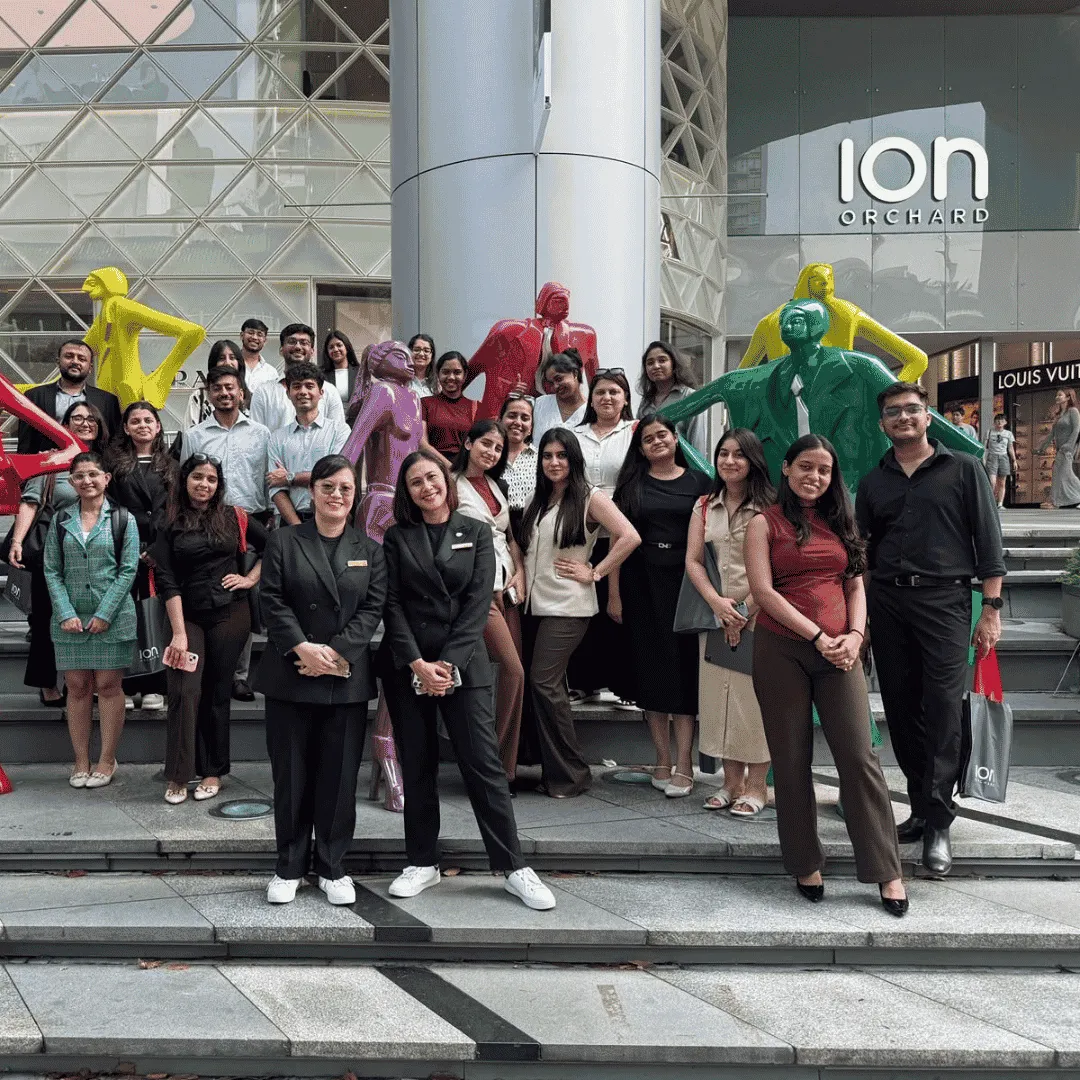
At ION Orchard, students examined a shopping mall as a deliberately designed customer-experience ecosystem, looking at everything from vertical segmentation across floors to the interplay between digital tools and human concierge services. At the Hyundai Motor Group Innovation Center Singapore (HMGICS), they saw AI, robotics and automation embedded directly into a smart-factory environment. At Standard Chartered Bank, conversations around AI adoption offered a closer look at how innovation is managed within a highly regulated institution.
The programme culminated in Convergence 2026, Jio Institute's flagship international conference. Students from the cohort moderated panels featuring industry leaders, bringing them from the role of learners to participants in a live conversation about how AI is reshaping business.
Cultural Immersion
Singapore itself became another case study.
In Little India, the cohort encountered a neighbourhood where streets, shops and eateries operate through a dense network of systems and routines. Across the city, the visible emphasis on cleanliness, organisation and ease of movement offered another perspective on how environments can be designed to reduce friction and shape behaviour.
By the end of the two weeks, the different experiences had begun to connect.
A strategy does not create value simply because it is well conceived. A technology does not matter simply because it is advanced. A brand does not remain relevant simply because it was once successful. Value comes from understanding the people being served, building organisations capable of delivering consistently, and knowing when it is time to change.
That question followed the cohort from the lecture hall to the shopping mall, from the smart factory to the conference stage: who is this really for — and is it still working for them?
Two weeks in Singapore offered the cohort many different ways to ask it, and just as many reasons not to stop asking.