
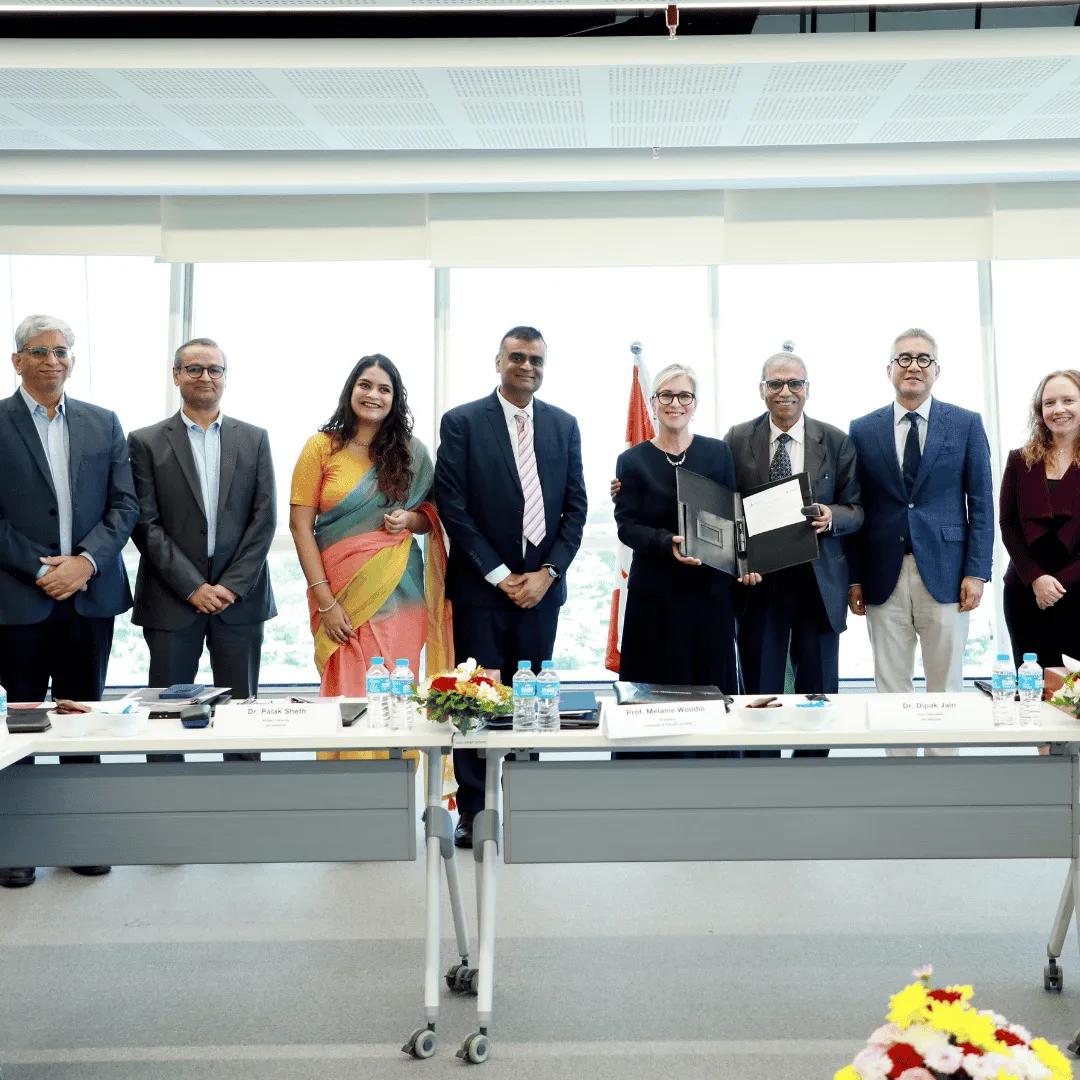
Talent Development in the Age of AI | 25 September 2026 | Jio Institute, Navi Mumbai
For years, the question educators and employers asked about artificial intelligence was simple: Which technical tools and coding languages should our graduates learn?
At the Jio Institute roundtable convened on the official visit of Prof Melanie Woodin, President of the University of Toronto, the question had fundamentally changed.
As artificial intelligence moves beyond task execution to automating full workflows, a more foundational inquiry is emerging: what defines the human "X factor"—and how do universities, enterprises, and research labs co-create knowledge, foster critical inquiry, and prepare talent to ask the questions that truly matter?
This question shaped the high-level dialogue on "Talent Development in the Age of AI," held at Jio Institute, Navi Mumbai. Bringing together academic leaders, enterprise HR and technology heads, startup founders, and ecosystem builders from India and Canada, the morning examined future-ready talent architectures, research partnerships, and higher-education pedagogy.
Delegates from the University of Toronto, the Consulate General of Canada in Mumbai, IIT Bombay, IIT Hyderabad, and senior enterprise leaders from Reliance Industries, Brookfield, and Motilal Oswal joined the discussions.
A Transnational Alliance: The MoU Signing
A defining milestone of the morning was the formal signing of a Memorandum of Understanding (MoU) between Jio University and the University of Toronto.
The partnership bridges one of the world's premier research universities with an emerging Indian institution built for an AI-led future. Opening the door to deeper cooperation in advanced teaching, collaborative research, startup innovation, and bilateral student and faculty mobility, the alliance establishes an institutional bridge between India and Canada to co-create knowledge and nurture globally competitive, future-ready talent.
The "X Factor": Cultivating Judgement and Epistemic Curiosity
The session opened with an examination of what remains uniquely valuable as AI systems become universal commodities.
Moderated by Dr Shailesh Kumar, Dean, Jio Institute, the panel emphasized that tools, platforms, and coding syntax are quickly learned and discarded. The enduring differentiators of AI-era talent are foundational curiosity, rigorous problem framing, and the willingness to interrogate and challenge machine-generated outputs.
Technology adoption is compounding at an unprecedented pace—noting that while radio required 38 years to reach one million users, ChatGPT reached that mark in India within five days. In this hyper-accelerated landscape, uncritical trust poses significant systemic risks. Talent must understand the cost of getting it wrong, particularly in high-stakes fields like healthcare and financial services. The academic and corporate consensus was clear: institutions must evaluate learners on their "AI judgement" and learning agility rather than superficial tool fluency, treating human intellect as an evolving learning curve rather than a fixed commodity.
Bridging the Research and Industry Divide
The dialogue then turned to the structural divide between academic inquiry and industrial application.
With private industry commanding massive computational infrastructure and proprietary datasets, fundamental discoveries are increasingly driven outside university laboratories. Bridging this gap requires innovative institutional models, including joint faculty-industry appointments and multilateral data consortia among "middle powers" that pool research architectures while safeguarding data sovereignty.
Prof Ganesh Ramakrishnan (BharatGen, IIT Bombay) and Dr Uday B. Desai (Founding Director, IIT Hyderabad) noted that impactful research is not confined to monolithic, generic models. Small, localized, and domain-specific models—such as clinical tools predicting patient emergencies hours in advance, or multimodal engines capturing India’s 22 Indic languages—demonstrate how academic scholarship directly addresses pressing societal challenges.
Pedagogy and Closing the Readiness Gap
How should academic curricula evolve when machines can generate answers instantaneously?
Participants addressed the six-to-eight-month readiness gap separating university graduates from productive corporate and research contributors. Much like calculators in previous generations, AI’s pedagogical role must be discipline-specific. While humanities seminars may exclude screens to preserve deep dialectical debate, disciplines like genomics, computational biology, and chemistry must place AI at the center of the laboratory bench.
Enterprise leaders—including Ms Meenakshy Sridhar (Reliance New Energy), Ms Sareeta Bhatikar (Jio-bp), Mr Siddharth Sureka (Motilal Oswal), and Mr Mitesh Bidawatka (Jio Financial Services)—cautioned against both organizational reluctance to adopt AI and blind, uninformed reliance on it. Closing this gap demands continuous leadership education, longer experiential internships, interdisciplinary student teams, and early immersion in live problem-solving environments.
Startups and Venture Translation
Turning to venture creation, startup leaders like Mr Kerem Topal Ismail Oglou (Xatoms) and Mr Amey Mashelkar (JioGenNext) observed that while AI drastically compresses product development timelines, it cannot substitute for deep domain intuition and field insight.
Innovators must design solutions directly for end users—such as agricultural workers and municipal teams—rather than abstracting problems in isolation. For universities, enabling meaningful commercial translation requires flexible intellectual property policies, seed grants, and academic environments that connect technical developers with frontline domain specialists early in their journey.
From Knowledge to Wisdom
In her keynote address, Prof Melanie Woodin, President of the University of Toronto, traced Toronto’s pioneering heritage in artificial intelligence—from Geoffrey Hinton’s foundational neural network breakthroughs to modern AI-driven "self-driving labs" at the Acceleration Consortium. With U of T ventures raising over $27 billion, she observed that transformative discoveries stem from four enduring human traits: creativity, curiosity, pushing boundaries, and persistence. Preparing talent for the modern era requires higher education to lean deliberately into human intellect.
Dr Dipak Jain, Vice Chancellor of Jio Institute, framed the future around a simple truth: "The future of competition is collaboration". Reminding the forum that all universities share the overarching mission of developing human capability, he envisioned India as a global talent hub. Welcoming the delegation, Dr Palak Sheth, Project Director, shared Jio University’s vision for a 410-acre permanent campus integrating an academic district, research park, and incubation hub to build an enduring Gyan Bhoomi.
One Morning. One Larger Question.
Across every keynote and panel, the roundtable approached talent development from multiple fronts—academia, enterprise, startups, and governance.
Yet the conversation returned to the same realization.
AI will continue to automate tasks, generate outputs, and optimize workflows. But human beings must determine which problems are worth solving, interrogate the outputs, and carry ultimate accountability for the outcomes.
As Dr Shailesh Kumar concluded, just as it takes a village to raise a child, building responsible AI talent requires the entire ecosystem to align. Technical proficiency may provide the acceleration, but human wisdom and critical judgement will always provide the steering.